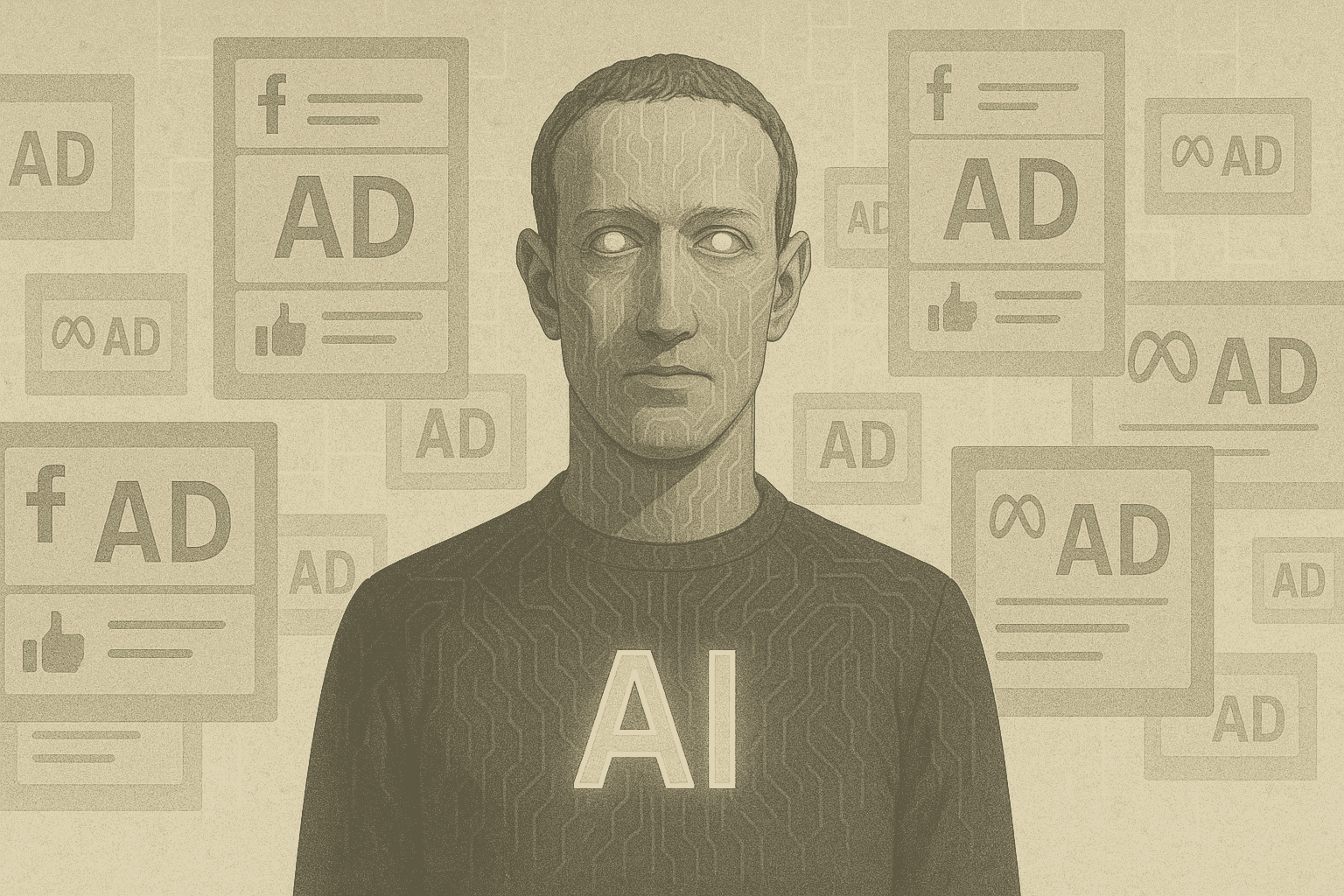

I think we could have all seen it coming – the age of AI driven Meta Ads. Meta has always been ahead of the curve when it comes to incorporating AI into ads. We have seen iterations over the years with the likes of Advantage+ campaigns, and more recently Generative AI creative – but now Zuckerberg is looking at a tectonic shift in how advertising will function over the next 12-24 months through Meta.
“By the end of 2026, advertisers will be able to ‘upload a product image, set a budget, and Meta’s AI will do the rest'”
M. Zuckerberg 2025
I don’t know about you, but I almost threw up a little reading that. As a performance marketer running Meta ads for well over 10 years, I could have predicted this was the way Meta was going for at least half of that.
Over time, Meta has slowly relinquished control from the advertiser and agency running the ads – removing or reducing interest targeting and leaning into 1st Party data or audience based targeting, adding in advantage+ elements on creatives (e.g. overlays, music, stretching ratios etc.) and then the Advantage+ shopping campaigns. The same kind of thing can be said for Google Ads with the introduction of Performance Max, or AIMax campaigns.
This is the direction paid advertising has been heading for some time, and it’s only just getting started.
Don’t get me wrong, advancements in AI, within paid media are powerful – bidding strategies are fuelled by AI, contextual placements are more accurate, and there is also a potential to open up new formats, and new platforms/placements with the advancements of AI Overviews, AI mode and LLM search.
However, all of this takes away one crucial element. The advertisers ability of control. Zuckerberg has set out a vision of the future where, we as advertisers, have no control over product, placement and positioning. No creative control, no targeting control.
Simply hand over the money, your concept, and Meta will do the rest.
Here’s what the proposed future of Meta Ads looks like:
- Input: A product image (or multiple), a business goal (e.g. ‘Drive Sales’), and a budget.
- AI Generation:
- Creative: Meta’s generative-AI suite will generate ad copy, video variants, image adjustments, carousel layouts, and even voiceovers.
- Audience: Based on Meta’s deep user graph, the system will predict who’s most likely to engage or convert.
- Media buying: Budgets will be split, tested, and reallocated in real-time across placements (Reels, Feed, Stories, etc.).
- Optimisation: Performance feedback loops will train the model to improve every ad variant and targeting decision continuously.
- Reporting: Automated insights, creative effectiveness scoring, and recommendations, again, AI-generated.
With the power of Meta’s algorithm for ads, you might put your money on your ads reaching the right users at the right time, but would you feel comfortable having no control over what creative shows to users, what users you are actually targeting? I’m sure a lot of advertisers will feel uneasy with this shift.
Will it work? We’ll have to wait and see.