If you’ve been following my posts on flowio or through my LinkedIn updates over the last 12 months, you’ll know I’ve been banging on about how ads, in particular e-comm ads will eventually come into play in AI platforms. It was only back in September 25 when OpenAI announced the Agentic Commerce Protocol – well, now Google are announcing the ‘Universal Commerce Protocol’ or UCP for short.
We’ve moved past simple chatbots in LLMs, we’re at the stage where AI will just do things. This is where the UCP comes into play – it’s infrastructure to make that happen at scale.
If you’re in PPC or eCommerce then it’s something to pay attention to, because the traditional ‘Search > Click > Website > Purchase‘ funnel is about to change for good.
Here is my deep dive into what the Universal Commerce Protocol is, how ‘Direct Offers’ (PPC in AIOs!) in Google Ads work, and what it means for advertisers.
What is the Universal Commerce Protocol (UCP)?
The way I see it is that the UCP is going to be a translation layer.
Up until now, if an AI agent (take Gemini for an example) wanted to buy a pair of trainers for you, it had to go off and read a website like a human, navigating the DOM, and finding the products it thought were relevant for you. While an actual AI agent may be able to go off and actually purchase the product – they are doing it in rather the same way that you and I do it. It’s trying to navigate the page, find an add-to-cart button, and hoping that the bot is not rejected.
This has been a fairly uncommon way to work agentic commerce up until now – we’ve seen the likes of Perplexity try it with their Comet browser. However, this is still working in an ’emulated human’ browsing style – and has angered Amazon to the point of throwing them a lawsuit for bad bot practices.
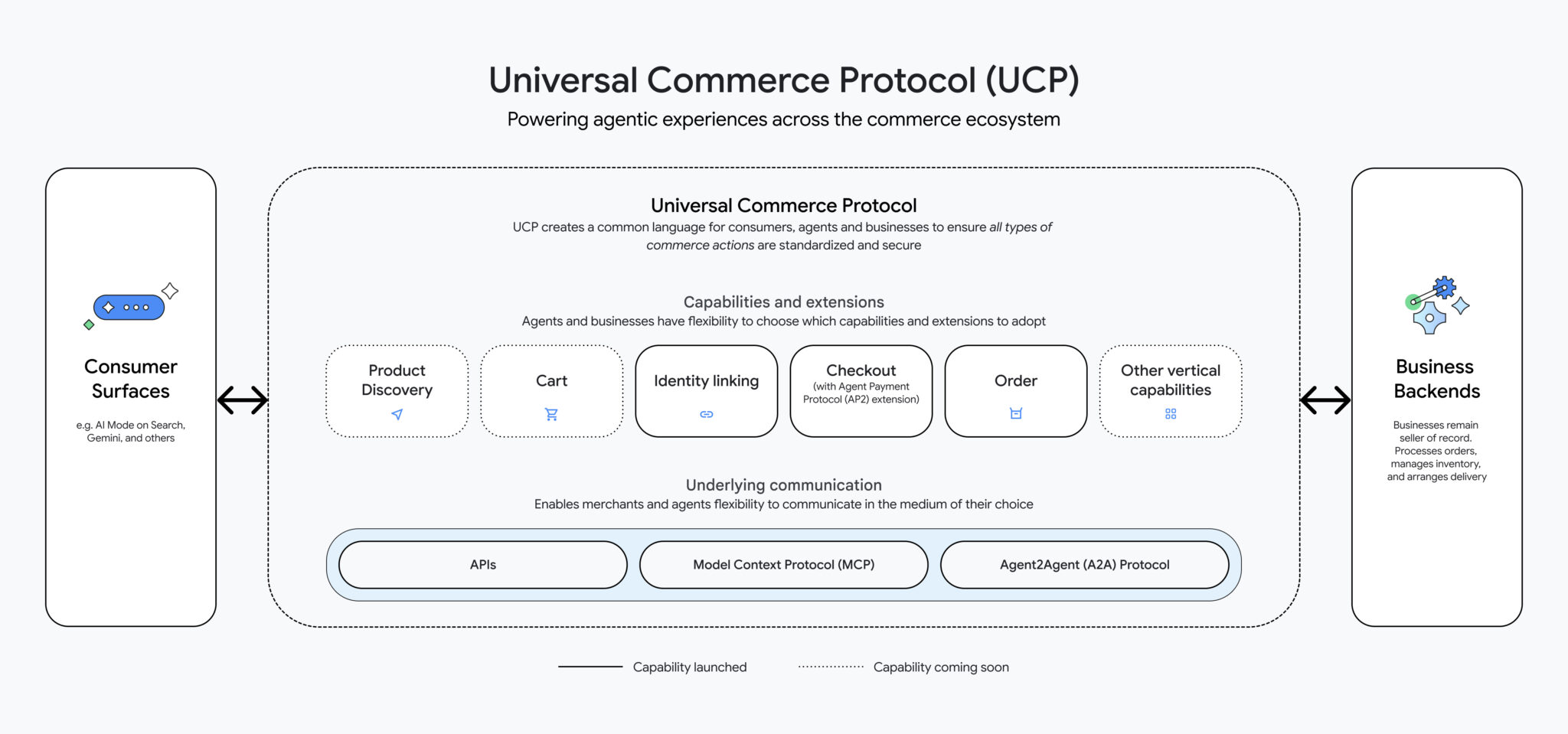
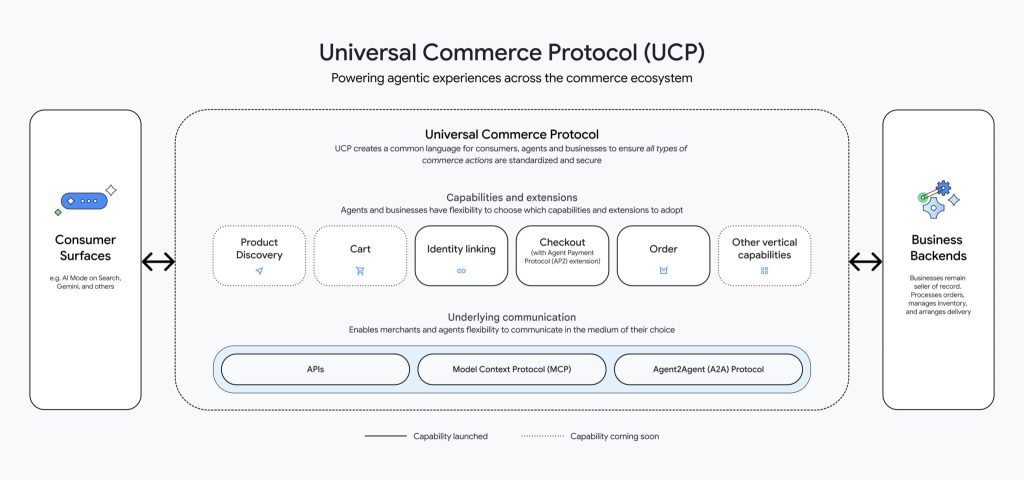
UCP changes this. It’s an open-source standard (co-developed with Shopify, which is huge) that creates a common language between AI agents and retailer back-ends.
Much like the Agentic Commerce Protocol co-developed by OpenAI and Stripe – having a large distribution platform like Shopify on-board is the key to roll this out across mainstream ecom sites.
In simple terms, instead of the AI viewing your site, UCP helps the AI to negotiate with it:
- Agent: “Do you have the Nike Air Max in Size 10?”
- Store (via UCP): “Yes – inventory count is 4”
- Agent: “Here is my payment token and shipping address. Buy it.”
- Store (via UCP): “Order #1234 confirmed”
All of this will happen within Google’s surface (AIOs or Gemini). The user never visits your website, but, and this is a critical part, you remain the Merchant of Record.
You own the customer data, the transaction, and the liability. Google is just the interface to make it all happen.
Imagine that – users need never visit your site, never experience all of the fancy UX and work that’s gone in to crafting a perfect customer visit. They can purchase indirectly, you get the order, you ship it, and it arrives at their address.
If you are a retailer, think of the UCP as another touchpoint to showcase your products, giving you the ability to surface across AI Mode in Google Search and through Gemini. You’ll remain in control of the logic and checkout experience utilising your business backend.
The Google Ads Angle: “Direct Offers”
This is the part that really got my attention as a PPC guy. Alongside UCP, Google announced a new format of ad that will start to surface within AI overviews and Gemini search only when signals indicate that a user is close to purchasing: “Direct Offers”.
We’ve all worked with ‘Promotions’ within Google Merchant Center when dealing with Shopping Ads. This is different. Direct Offers are technically promotions within GMC – but are specifically for AI Mode in Search and Gemini.
From what I can gather – the AI will detect high purchase intent during a conversation. Let’s say I am searching for a new laptop within AI Mode, I’m asking Gemini about battery life on several different models of laptops. If an ecommerce advertiser was running a Direct Offer campaign – Gemini can surface a context-aware deal:
“If you buy the Asus Zenbook right now, here is 20% off and free shipping”
It’s not an ad as we know it, it doesn’t work on keywords, and it’s not about optimising your product titles within a Google Merchant Center product feed. It’s a fully context-aware deal surfaced at exactly the right stage of the buying cycle.
But… hang on a minute – of course this is a very early stage announcement. It’s in a closed pilot (typical Google), however from what I have gathered this would be a typical setup. It may end up very different on release.
- Campaign Type: It’s clear that to use this feature you will need a Performance Max campaign, or there may be specific shopping settings for normal campaigns (I would imagine PMAX is where this is going to live purely because this will need served in a complex context aware way).
- Triggers: There are no keywords to bid on. You define the offer value in Google Merchant Center (e.g. 20%) and the context (e.g. “Competitor Comparison” or “Cart Abandonment Risk” etc.). It’s unclear at this point in time how the context triggers will be defined or selected, but one can imagine there may be some ‘pre-defined’ triggers to select from.
- AI Orchestration: Google’s AI decides when to surface that offer to close the sale (and burn the margin).
On the official Google developers blog, there is a guide that provides detailed instructions on how to integrate with the Universal Commerce Protocol on Google, covering the additional steps that you’ll need to take to enable transactions. https://developers.google.com/merchant/ucp/guides
The steps include preparing your Google Merchant Center (configuring shipping, returns, and product feed to enable users to discover products across Google surfaces. I can’t say it enough, but in the age of agentic commerce – your product feed, and more importantly Google Merchant Center account should be a key priority for optimisation. Google also notes that once you’ve done these required steps in GMC (US only for now) you can join the waitlist – your integration will also require approval.
One of the major requirements for your product feed and GMC is that you must update your product feed to signal eligibility and provide compliance data. This appears to be quite similar to OpenAI’s ACP protocol for product feeds – in that it would appear to allow you to opt products in or out of embedded checkout experiences. The attribute ‘native_commerce‘ will allow you to decide which products to include agentic checkout eligibility, and which to exclude. Set this to false for any products you do not want included to have agentic checkout experiences.
Product warnings and compliance are also mandatory to allow agentic checkout eligibility. If you have any products with regulatory or warning requirements you will need to include compliance notices within your feed. Google has provided instructions for this in the official documentation – provide ‘consumer_notice‘ attribute group within your feed with two sub attributes: ‘consumer_notice_type‘ (must be legal_disclaimer, safety_warning or prop_65) and consumer_notice_message (a string of up to 1000 characters – however you can use HTML tags within this which is interesting).
An interesting note that Google recommends using a supplemental feed to provide these details into your main product feed to avoid impacting your primary feed.
As usual with Google Merchant Center new features, there are a range of product restrictions including any service, financial products, customisation of goods, pre-order items, age restricted items and digital goods. It’s worth checking the official documentation if you are unsure whether your goods will be eligible.
How To Setup UCP (The Technical Bit)
If you are a technical marketer or developer (like me), you’re probably wondering about how to integrate and setup the UCP. Whilst this is a very new announcement, and more technical details will likely follow – from what I have gathered here are some pointers about what to start on now.
- If you are on Shopify: You are in luck. Because Shopify is co-developing this, the integration is rolling out as a native toggle in the Google and YouTube App. It will automatically map your Shopify product data to the UCP standard. You just need to enable the “Agentic Checkout” (or similar name) feature in the settings.
- If you are on a Custom/Enterprise: You may have some coding to do. You need to expose endpoints that follow the UCP schema. This will involve:
- InventoryCheck: Real-time stock checking and querying.
- CartCreate: Building the basket via the API.
- ContextNegotiation: The ‘Handshake’ with the AI.
The whole setup relies heavily on the Model Context Protocol (MCP) – something I wrote about back in October. If you haven’t looked into MCP servers yet, then now is the time.
There is a brilliant guide that takes you through python examples of how the UCP operates, how to setup a business server to accept requests from an agent and invoke the checkout capabilities. If you’re interested in this, check out section 2.0 on the official Google developers blog article https://developers.googleblog.com/under-the-hood-universal-commerce-protocol-ucp/. We won’t go into this in detail here – as it’s all available and easy to follow on Google’s official blog.
Current Limitation (January 2026)
As this has only just been announced (11th January 2026) at NRF 2026 details are limited, and of course Google will be testing this within closed feedback loop cycles, so it’s unlikely to be on your radar for a while unless you are a lucky chosen one. Here are some of the initial limitations before you start talking to clients about it.
- Availability: It’s announced as US only for now. If you are here in the UK with me, we are probably going to be watching from the sidelines for a few months.
- Pilot Status: “Direct Offers” is invite-only for now. Again, don’t get too excited and start rushing to your Google Ads or GMC accounts just yet.
- Payment Rails: It currently favours Google Pay. Support for Paypal is announced as coming soon.
- Product Fit: It’s strictly for Retail (physical goods) – if you sell B2B, services or SaaS then UCP is not for you just yet.
My Take On Agentic Commerce
We are starting to see a major shift happen on the web. There is the ‘Human Web’ (visual, UX, HTML, CSS) and the ‘Agent Web’ (APIs, JSON, UCP, ACP).
“Retailers and eCommerce sites cannot ignore agentic commerce capability in 2026. These retailers need to start thinking about a different layer to the web – an underlayer that communicates, negotiates and provides product visibility directly with AI Agents, and this is where the UCP comes into play.”
Malcolm Gibb – Founder & CEO at flowio.co.uk
Both the Universal Commerce Protocol (UCP) and the Agentic Commerce Protocol (ACP) lay the groundwork foundations to build a full translation layer across the web that will allow AI agents to communicate, and more importantly negotiate with websites in a completely hidden world. It brings the ability for AI agents to act like humans without the human interaction, purchase goods without ever having to visit a website – and for the eCommerce brands that embrace this new behaviour it opens up a whole new world of customers.
Yet, the ‘agentic commerce’ web does pose significant challenges for retailers. How will ‘Direct Offers’ truly surface if many retailers are serving them across similar products. Will the best discount win, or will it be based on reputation, or even budget capabilities? Whereas you may have won the sale anyway, are you eroding margin by offering a discount in this way? That will remain to be seen, but in an already extremely competitive merchant market with tight margins – this may not be for everyone.
For retailers thinking about how to level up now – your Product Feed just became more important than your homepage. If product data isn’t structured to answer AI’s questions (attributes, real-time stock, shipping rules), you may simply be invisible in the new mode of purchase.
Next Steps? I’m currently researching this more and digging into the API documentation for UCP to see what retailers need to focus on, particularly for non-Shopify stores. Stay tuned for updates.
Need help automating your Google Ads or making sense of AI? Drop me a line at hello@malcolmgibb.co.uk or check out flowio.