With the latest announcement from OpenAI – ads will start to appear within ChatGPT over the coming weeks for US based users on free and Go subscription tiers. Combine that with Google’s announcement about Direct Offer ad placements to appear within AI Mode and Gemini for product based searches – the world of paid advertising is about to experience a big upheaval.
Paid advertising professionals have long known that ads would eventually come to LLMs. The rumours have been circling for months through different platforms. Finally they appear to be coming with tests being rolled out across both Google Gemini and ChatGPT over the coming weeks and months.
It does pose a question though. In the age of AI ads – how will we measure effectiveness?
The Attribution Question
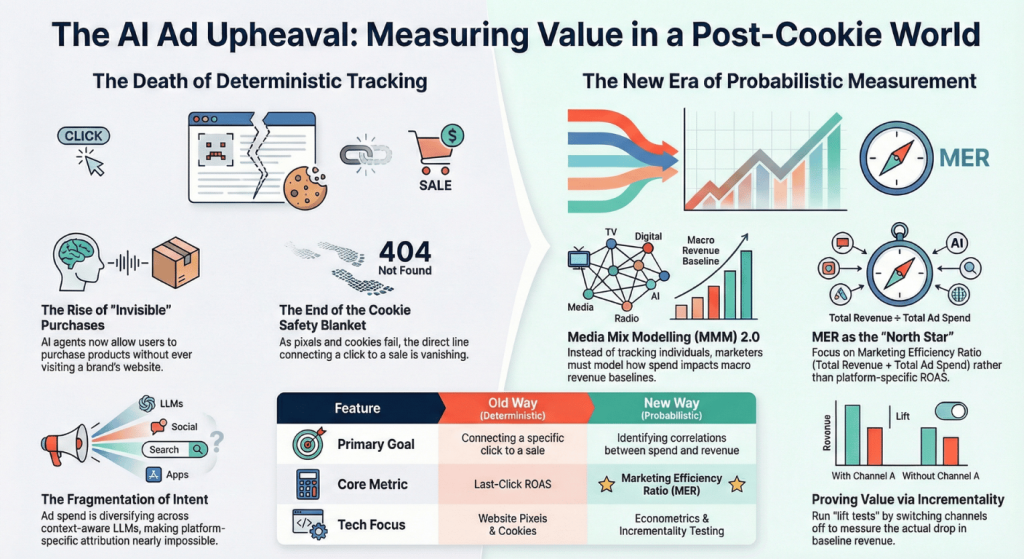
As a PPC marketer – attribution has always been a cornerstone of proving effectiveness of paid media within the buying journey. Whether that’s an upper funnel TikTok Ad, YouTube view-through or a last click Google brand ad, we’ve always been able to roughly calculate or verify which channels, and more importantly data related to those channels have contributed to the end sale. Most attribution methodologies work either from pixel based technology, or through machine learning principles. Cookies are on their way out, and have been for a long time.
Take this hypothetical buying journey as an example:
A user is looking for a new pair of Nike trainers. They’re not really at the point of purchase – they just know they need a new pair at some point.
Because they’ve previously visited Nike.com, they see multiple ads that they scroll past on TikTok.
When watching YouTube on their TV they experience non-skippable ads from Nike.
They start to research different Nike trainers on ChatGPT, asking about different fit sizes and the newest product releases for 2026. ChatGPT surfaces 3 ads at the bottom of the page for 3 different retailers selling Nike trainers. The user clicks on these and chats with the brand chatbot – but doesn’t go through to the website.
They do a Google search for “Nike air max size 10” in Google, and are presented multiple Shopping ads for different products – all from resellers with different pricing and offers.
They start to use AI mode to compare the different retailers for delivery, reviews and price.
Google surfaces a Direct Offer within AI mode – it’s from an online only retailer and displays “If you buy this pair of Nike Size 10 Air Max today we’ll give you 20% off and free next day delivery”.
The user is enticed and hits the purchase button in AI mode. Hits pay with Google – and transaction complete.
Trainers arrive the next day and the purchase journey is complete.
Here’s the thing though – the user never once visited a website.
This is the future of what paid marketers must be prepared for. The purchase happened through the UCP, or Universal Commerce Protocol. A communication layer for an ai agent to act and purchase on the users behalf directly to the retailer.
Not once did a ‘cookie’ drop, or a website session start – except months ago when they had visited Nike.com.
Of course – we can see from the disparate ad platforms that impressions had fired on a TikTok ad, view-throughs had happened on YouTube, impressions for Shopping Ads, even possible that our GPT ads had surfaced, and possibly that our Direct Offer in Google Merchant Center had an end-sale.
But how does all this join up?
It doesn’t – and that is the new world of advertising that we live in.
The Renaissance of Econometrics (or: How to Measure the Invisible)
If the “Nike journey” scenario paints a terrifying picture of world without cookies, clicks or sessions, it begs the question: How do we provide any of this works?
For the last 15 years, particularly in my field, digital marketers have been spoiled by deterministic data. We became addicted to the precision of “User A clicked on ad B and bought Product C” at our fingertips. We built entire careers, agency models and budget requests on the comforting illusion of 100% trackability. Take the shift from Universal Analytics to Google Analytics 4 for instance, or even when AI Overviews started becoming mainstream and impacted organic tracking visibility.
In a world where transactions happen via AI agents and agentic workflows that completely bypass the website pixel, that safety blanket is gone.
We are not entering a new era of measurement; we are returning to an old one, supercharged by technology. We are pivoting from Attribution (tracking individuals) to Econometrics (modelling impacts).
Back to the Future: The “Mad Men” Approach
In the 1960s, advertising giants didn’t have Google Analytics. If Ford bought a TV spot or a billboard, they couldn’t track who looked at it and then walked into a dealership. Instead, they relied on Media Mix Modelling (MMM).
They looked at the macro pictures: “We spent $1m on TV in July, and sales went up 15%. When we cut TV in August, sales dropped 5%”.
When I first started my career in media and advertising over 15 years ago I witnessed this first hand. Working in a traditional media company – yet being a data-driven focused paid marketer – I watched the TV, Radio and Out of Home departments work, and plan media from almost zero validated data compared to how we do it in PPC.
In fact, this company let me go on a trip to a local radio station. When I was there I asked how they track numbers, listeners and how many people actually hear ads – from a digital marketing perspective I was taken aback by the response. “We use a survey and multiply it by x”. Back then this was a common approach, for radio RAJAR was commonly used as a means to “guess” how many people were actually listening to the radio. By no means a scientific approach – but it worked for media planning and impacts.
We did a lot of direct response Radio and TV adverts back in those days, and the correlation between a non trackable channel, and a trackable channel like Google Ads was stark. We often observed huge spikes at exactly the right times when these ads went out and could for around 90% accuracy determine the effectiveness of a single spot on Radio or TV for some clients.
For other clients, not so much. Trying to determine the impact of TV, Radio and OOH in some cases was like a stab in the dark. In some cases, brands didn’t really care about the direct return from their traditional media spend – they were the ones that understood that old school model of “spend does not always equal direct from channel sales”.
Much radio and TV is now connected via the internet with on-demand and DAB for example, and in a way more trackable ecosystem than it was before – but this method of calculating impacts on media was also the same for other mediums. Take TV for instance, in the UK ‘black-boxes’ were given out to a selection of the population. These would send back data periodically on what people were watching, giving TV companies a baseline data which they then multiplied by a number of thousands to account for the whole population. As with Radio – I was dumbfounded by the concept that brands were spending 10x as much on TV than in PPC without even a fraction of the ability to track, attribute and forecast.
These arbitrary calculations gave media houses ‘estimated impacts’ for primetime spots on TV. Not wholly accurate, not scientific – and for a mind working in PPC, completely unfathomable.
It taught me a lot about how traditional media worked, and how lucky we were in digital marketing to be able to track every behaviour, click, session and purchase back to the channel it originated from. For years in my PPC career, we calculated direct return from ad spend based on predictability, absolutes that generally came to fruition 90% of the time.
As pixels and cookies die, is MMM the only viable alternative to what used to be a razor-sharp accuracy of an advertising pixel?
The Shift: Deterministic vs. Probabilistic
The mental shift for most marketers here is moving from knowing to inferring.
The Old Way (Deterministic): “I need to see the line connecting the click to the sale.”
This is becoming impossible as the “messy middle” of the purchase journey gets hidden inside AI chat interfaces, or impressions from upper funnel activity spark curiosity and brand interaction.
The New Way (Probabilistic): “I need to see the correlation between activity and revenue”
In the AI-search era, you might not see the click that led to the sale of those Nike trainers. But, using modern MMM, you will see a signal: “Every time we run 20% off Google Direct Offers through AI Mode – for every £1,000 spent, our overall specific product revenue baseline lifts by £3,500”.
You don’t know who bought it, you don’t know if they clicked on several brand ads before the end sale, you don’t know if they bought it on a Tuesday or Wednesday. But, you know the money in equals profit out.
The ability to draw insights from bottom-line profit is the key to understanding top-level insights. Most marketers are scared of this. It’s not concrete, not scientific and more often than not they don’t or can’t see this level of data when they run accounts.
Marketing Efficiency Ratio (MER) as the North Star
“So, if the dashboard says zero conversions, but the warehouse is empty, how do we report to the CFO? We have to let go of the dopamine hit of the ‘last-click’ attribution. The future isn’t about tracking the user; it’s about tracking the correlation. We are entering the era of real-time Media Mix Modelling (MMM). We won’t ask ‘Did this user click?’, we will ask ‘When we increased spend on ChatGPT, did our overall velocity of sales increase?'”
As we lose granular visibility, the obsession with platform-specific ROAS (Return on Ad Spend) must end. A ROAS of 10.0 on Google Ads is meaningless if your total business revenue is flat.
Too many agencies hype over ROAS figures, when in reality the clients they serve are barely moving the needle year-over-year. Even in the realm of POAS (Profit on Ad Spend) this can be misleading – especially in the PPC world. It fails to account for the fact that, for instance PPC brand ads might have been stealing traffic away from organic, or cannibalising non-branded terms, and it also fails to account for a multi-channel wide mix of media that may have driven that amazing POAS you produced on PPC ads.
The industry needs to embrace MER (Marketing Efficiency Ratio), often called “Blended ROAS”. I know what you’re thinking, we’ve just downplayed ROAS, but hear me out.
Marketing Effectiveness Ratio (MER) = Total Revenue / Total Ad Spend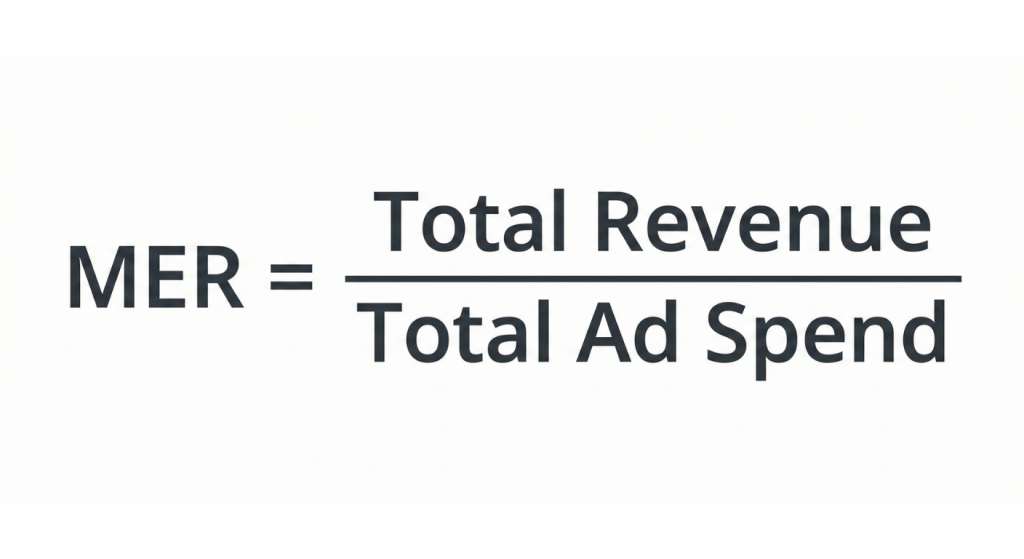
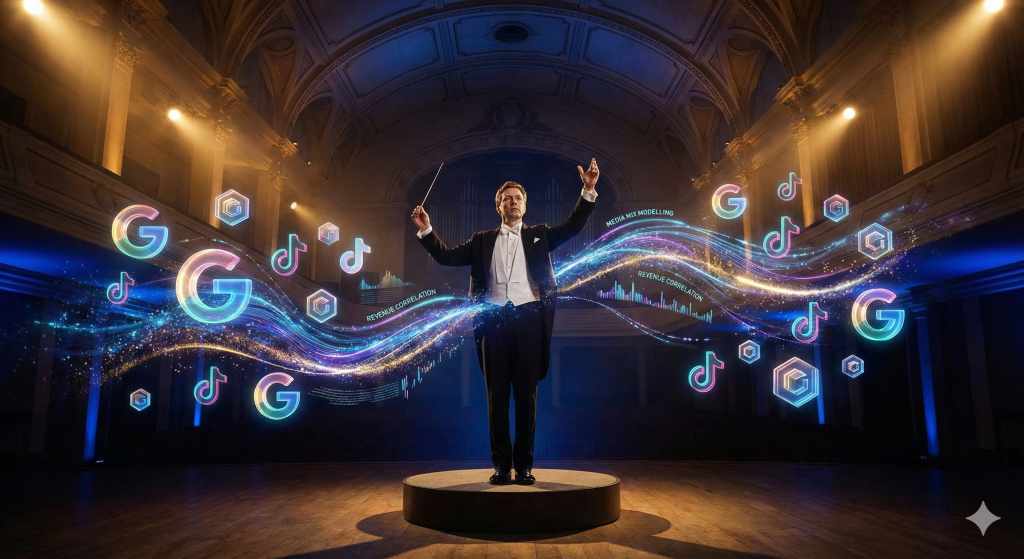
In the “Universal Commerce” world, your AI ad placements, your TikTok views, and your Google Direct Offers all contribute to a single ecosystem. Most attribution platforms that try and take all of that and provide probabilistic views of the ecosystem often fail to account for a full media mix. Trying to credit one specific channel is like trying to credit a specific instrument in an orchestra for the applause. You can’t. You have to judge the performance of the symphony as a whole.
Incrementality is the New Truth
If we can’t track the user, we must test the lift. This strangely enough brings me back a few years to how we used to test direct response TV, Radio and even Google Ads brand ads. We’d turn it off and turn it back on again, over and over until we had statistical significance. Yes, that old ad-age.
The concept is simple, take your Google brand ads for instance. How do you really know they are contributing to your bottom line revenue, and not simply cannibalising your organic brand listing sales? Is there any incrementality in having both serving at the same time? Most PPC managers will simply try and argue to a client that running brand ads is necessary for things like protecting brand space and competition. In reality 8/10 cases, it’s a waste of spend.
It’s difficult to test this theory though, or is it? One of the ways I used to do this was to run a 12 week lift test. Week one: Brand ads on, Week 2: Brand ads off, Week 3: Brand ads on, and so on. At the end of the test you have 12 rows of data. 6 weeks on, 6 weeks off. This normalises the data for seasonal peaks and troughs and gives you an even split. Compare this with your organic data impressions, clicks, CTR%, Conv Rate% – and bottom line weekly revenue, and typically in most cases it’s clear as day whether running brand ads on Google is money well spent.
It’s not just brand ads you can do this with either, I’ve done similar tests with whole channels. Turning Meta ads off for a specific region to find out that the “10x ROAS” Meta ads was reporting was in fact false – and nowhere to be seen on the bottom line revenue. Of course – there are those that will say “Well, Meta ads contribute further up the journey and lead to the sale”. Well, if that was the case then surely we’d see a decline on bottom-line revenue over the next 12 weeks when Meta was off.
It sounds basic – and it is. Most advertisers and large brands jump into complex attribution solutions to try and solve these simple questions. Of course, there may be several other variables, channels and media in the mix at play that impact incrementality, but at the end of the day, if you don’t see an improvement or a decline in the end revenue figures then that channel is barely having an impact.
In the new world of AI search, AI ads (and website visits), the brave marketers prove value by turning things off:
The Test: Switch off ChatGPT ads (when they release) for US users for two week.
The Observation: Does the baseline sales volume for that region dip over that time, or in the following weeks?
The Conclusion: If sales drop by 10% while the ads are off, that 10% revenue is attributed to that channel, regardless what the “click report” says.
The exact same methodology can be used for other channels: Meta Ads, TikTok, you name it. It’s not a scientific method, but isn’t marketing an art rather than a science?
The Age of AI Ads
I’ve talked a lot about the possibility of how we measure ads in an age of AI search, agents purchasing items without a human ever visiting a website – but there is another side for paid advertisers to consider: the advent of ads in a context-aware ecosystem.
We are moving into an era where Google Ads is not going to be the sole dominant platform for paid advertising. Around 10 years ago clients were only interested in Google Ads – that’s where 90% of their ad spend would go. The other 10%? Probably Bing ads, at that time. Move forward five years and it’s probably split around 70% Google, 25% Meta Ads and again a tiny slice on other channels.
Today, paid advertisers need to consider a whole host of ad platforms, all with entirely different ad formats and psychology. Google Ads, Meta Ads, TikTok Ads, and now LLM-based ads.
But where do AI., or LLM-based ads sit within the overall journey? Are they awareness? Intent? Are they bottom of funnel?
It’s hard to say what LLM-based ads will look like in 2027, but what we do know in 2026 is that Google’s Direct Offer based ads will sit right at the bottom of the funnel to close purchases. An intent-aware format designed to capture end-sales with offers and discounts directly within the LLM. ChatGPT’s ad announcement suggests a format slightly higher up, with a context-aware model that understands when a user is in the mood to purchase – it will surface brand led ads at the bottom of the page for free and Go tier users. For GPT in particular this is going to be fairly low volume – it misses out on the volumes of users on Plus/Pro and Enterprise plans who use GPT daily for work, life and more. Whereas everyone has a Google account right? Even in incognito, and on paid workspaces it’s likely AI Mode and Gemini will serve you an ad.
Whatever the format, we can be sure that the ad ecosystem is fragmenting, and diversifying. It’s now not simply about managing keywords, ad formats and budgets – it’s about understanding intent to purchase, where users are asking questions, and ensuring your ads are there.
We are likely to see a seismic shift over the next 12 months in terms of attributed data (from AI ads, and loss of cookie data), volume and control of data (from AI agents meaning humans never visit your perfect website) to a new skillset advertisers need to build to serve ads in a context-aware and intent-aware ecosystem.
Final Thoughts
I am old enough to remember when Google first launched ads. Before that, my dealings in banner exchanges, Yahoo penny ads and display seemed like a far off world compared to the new exciting age of Google Ads.
It feels like that again, new players, new ad formats, and new ways to think about how paid advertising fits into the mix. The biggest challenge we will all face as advertisers is how we verify and prove effectiveness of ad spend. It is becoming harder to attribute a multi-channel ecosystem, and will only become even more so in the age of AI agents emulating human interactions.
It’s an exciting time for PPC advertisers like me, but also a challenging one. New skills to learn, new ways of thinking – and new ad formats to serve.
